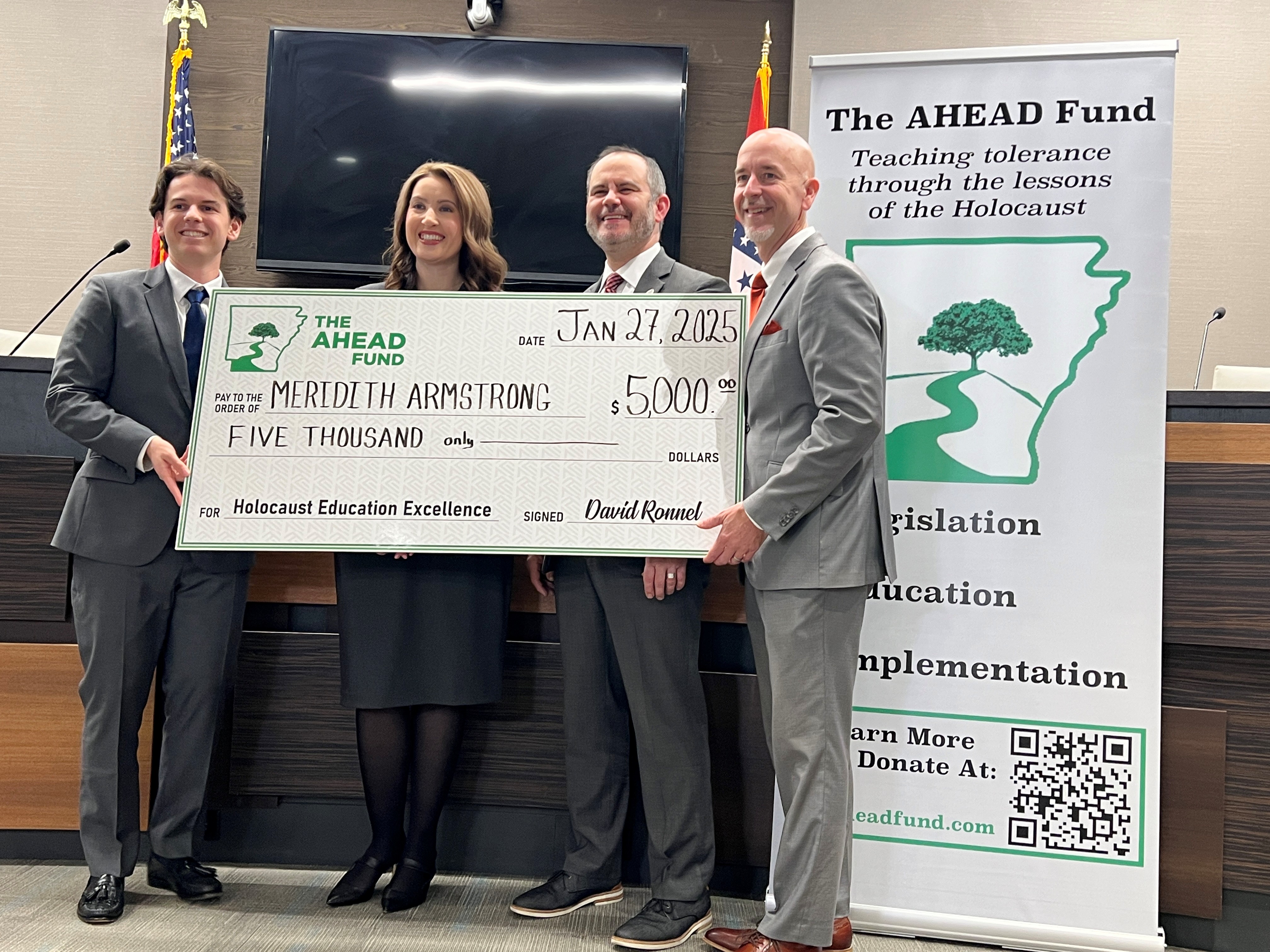
Meridith Armstrong, an 8th grade history teacher at Goza Middle School in Arkadelphia, was awarded $5,000 from The AHEAD Fund on January 27 at the Arkansas Department of Education building in Little Rock.

January 27 marks International Holocaust Remembrance Day, commemorating the victims of the Holocaust. In 2021, thanks to the efforts of former Governor Asa Hutchinson, Arkansas passed a state law requiring Holocaust education be taught in all public schools for grades 5-12. In 2023, Governor Sarah Sanders signed legislation into law that designates the last week in January as Holocaust Education Week in Arkansas.

The AHEAD Fund (Arkansas Holocaust Education Award Donation) is held at Arkansas Community Foundation. The fund recognizes Arkansas educators who go above and beyond in teaching the powerful lessons of the Holocaust.

Click here to learn more about The AHEAD Fund.
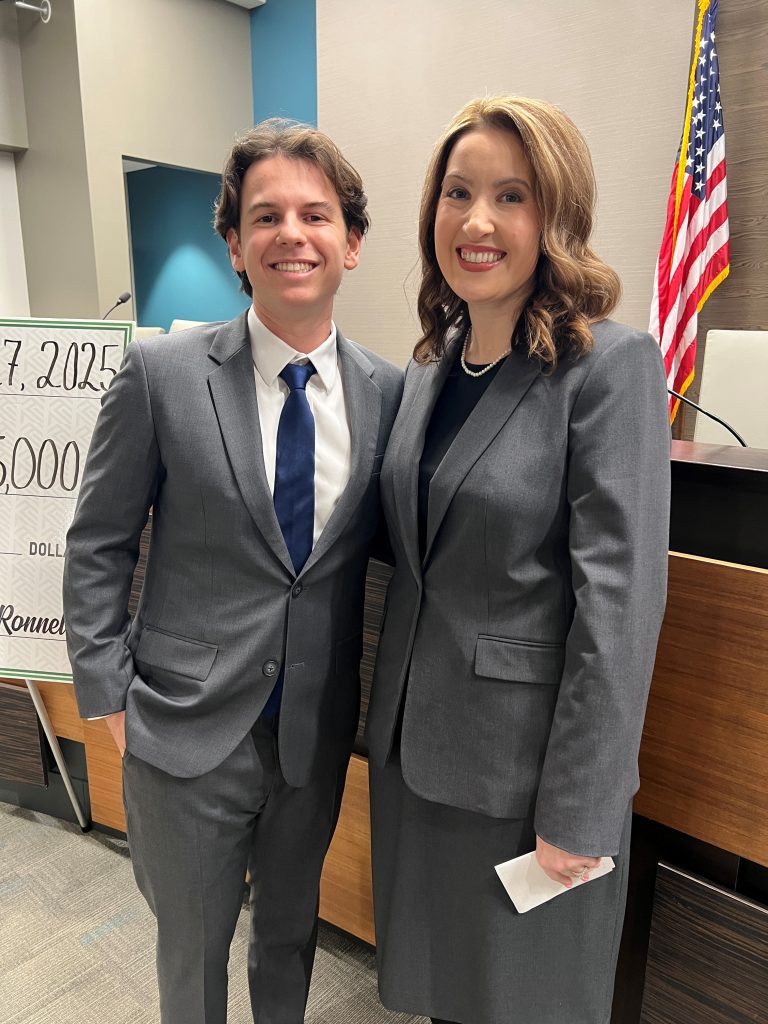
“We are thrilled to celebrate one of Arkansas’s finest educators, Meridith Armstrong. Her passion for teaching the Holocaust is inspiring,” said David Ronnel, Founder of The AHEAD Fund. “Her grandfather, a World War II veteran, instilled in her the importance of Holocaust education and remembrance. In her Arkadelphia classroom, Meridith brings creativity and energy. Holocaust survivors have spoken to her students and she assigns research projects and Ted Talks on the Holocaust. She incorporates Holocaust-specific art, music and food into her lesson plans while also helping her students gain empathy, understanding and appreciation for the things that makes us different, unique and most of all, human.

“On this day, 80 years ago, Allied troops march into the concentration camp known as Auschwitz. They witnessed unimaginable scenes of horror surrounding the systemic murder of more than 11 million people,” said Ronnel. “These liberators were heroes, freeing innocent men, women and children who somehow survived these atrocities.

“Today, the AHEAD Fund serves to honor the memories of the victims, survivors and liberators of the Holocaust. At the beginning of Arkansas’ second annual Holocaust education week, we are encouraged, knowing that more schools across Arkansas are teaching students about humanity’s darkest hours, so that it is never forgotten and never repeated.”
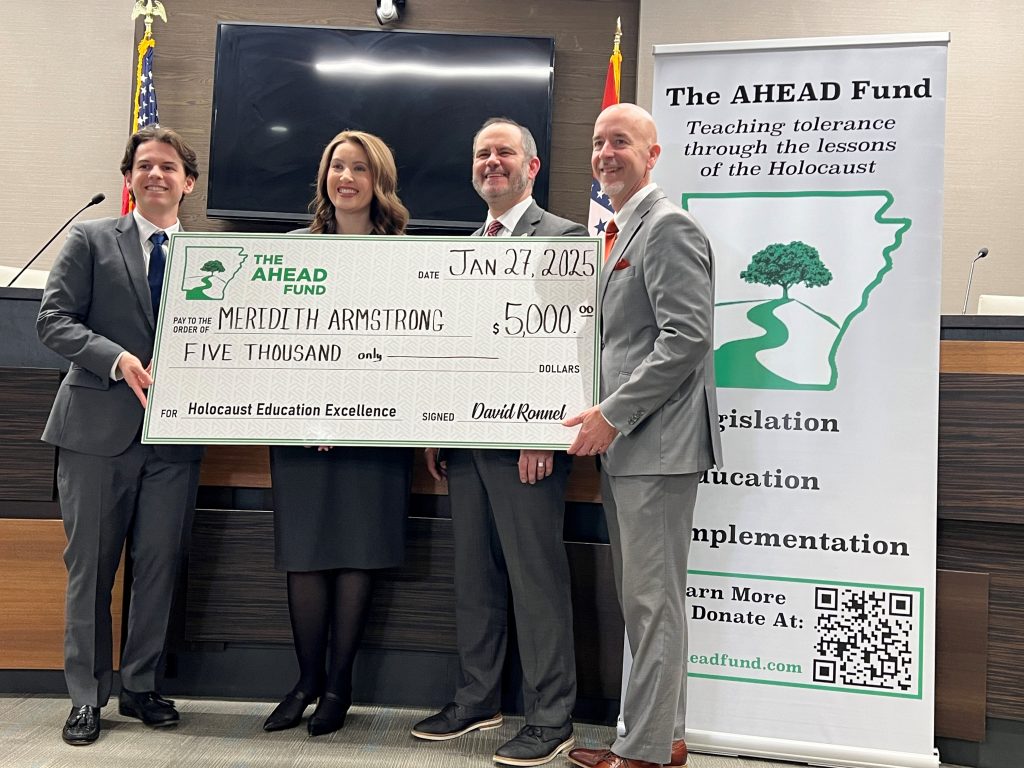
“Holocaust education is important because it can teach students to speak up against injustice, and act as allies to those who are unjustly targeted and marginalized,” Ronnel said. “It can create a more tolerant outlook by helping students become more open to viewpoints that might be different from there own. And, with the flood of misinformation online, including a growing number of claims denying that the Holocaust ever even happened, its important now more than ever, that students learn from the horrible mistakes of the past.”
A quasi-endowed fund was designed for people and organizations that want to enjoy the excitement of giving larger grants now along with the benefit of investing for future growth. These funds are invested in the markets to keep them growing, but there’s no limit on the amount that can be granted from your fund to the organizations you choose. A quasi-endowment requires a $100,000 minimum to start and the balance must remain above $50,000 for the first three years.

Download this one-pager to learn more about about how a quasi-endowment works

A recent example of a quasi-endowment in action is held by Habitat for Humanity of Central Arkansas. Like many other nonprofits, Habitat relies heavily on annual giving and donations of all sizes year-round from their donors, but the use of a quasi-endowment allows them to access funds for emergency use and for special initiatives to boost their impact. The pandemic proved a prime example of this. It showed Habitat (and many nonprofits) the importance of growing and maintaining a strong reserve.

“Just like our homeowners must save for the closing costs of their new home, we must save for when a once-in-a lifetime opportunity presents itself to us as well,” said Kelly Fleming, executive director of Habitat for Humanity of Central Arkansas.

Because of a quasi-endowment, Habitat is able to have an impact now, and preserve funds for future use.

In addition to quasi-endowments, the Community Foundation helps donors manage three types of funds depending on the amount they want to donate, desired impact and time horizon. Learn more about the multiple ways to give here.

Arkansas Community Foundation is honored to receive the 2022 Advancing Equity Award from the Clinton School of Public Service and their Center on Community Philanthropy.

Watch the announcement here.

The Advancing Equity Award is presented to organizations using innovative solutions to address racial inequalities in their communities and advance progress toward inclusion. The award recipients will receive support to continue and enhance their efforts. The National Day of Racial Healing (NDORH) is an opportunity for people, organizations and communities across the United States to call for racial healing, bring people together in their common humanity and take collective action to create a more just and equitable world. NDORH is a part of the W.K. Kellogg Foundation’s Truth, Racial Healing & Transformation (TRHT) effort – a national and community-based process to plan for and bring about transformational and sustainable change and to address the historic and contemporary effects of racism.

The largest grantmaker in the state, Arkansas Community Foundation is a statewide nonprofit organization that offers tools to help Arkansans protect, grow, and direct charitable dollars while learning more about community needs. The Community Foundation engages people, connects resources, and inspires solutions to build community. You understand your clients’ charitable goals. We understand smart giving. Partnering with the Community Foundation, you stay in control of your client relationships while we provide the tools and resources to make the philanthropic process simple, flexible, and efficient.

Here is what is going on and how the proposed changes might affect charitable giving strategies. 

Under President Joe Biden’s proposed tax plan, taxpayers making more than $400,000 per year would be taxed at a top income tax rate of 39.6%, an increase from 37% under current law. That would mean charitable giving would become more advantageous under the new law for some taxpayers.

A separate provision in the proposed plan, however, would impose a 28% limit on charitable deductions for taxpayers who make more than $400,000 per year. This would mean that instead of avoiding income tax on charitable gifts at the rate of 39.6% as described above, these taxpayers would escape income tax only at a rate of 28%. (A similar provision was proposed, but never enacted, during the Obama Administration.) 

The tax proposal also calls for increasing—from a maximum rate of 20% to 39.6%—the capital gains and dividend tax rates for taxpayers whose annual earnings exceed $1 million. For affected taxpayers, this change would create opportunities to avoid significantly more tax than is possible under current law for gifts of appreciated assets. An increase like this would create a huge incentive for philanthropists to support charitable organizations.

Next, the tax proposal calls for a 3% reduction of itemized deductions for taxpayers making more than $400,000 per year. This is reminiscent of the so-called “Pease Amendment” that was repealed in 2018. Although the reinstatement of this rule could have some negative effects on charitable giving, the rule’s impact would be blunted for taxpayers for whom the reduction is absorbed by other types of itemized deductions (mortgage interest payments, for instance).

Perhaps the component of President Biden’s proposal with the biggest potential impact on ultra-wealthy philanthropists is his intention to raise estate taxes and change the way capital assets are taxed after death

Currently, the gift and estate tax exemption per person is $11.58 million and $23.16 million for a married couple. These amounts are effectively double what they were before the Tax Cuts and Jobs Act of 2017 (TCJA). The TCJA calls for an automatic sunset of these increases on December 31, 2025, at which point the exemption will drop back down to $5 million per person, as adjusted for inflation. Under Biden’s proposed tax plan, though, the estate and gift tax exemption and rates would be restored to the lower levels of more than a decade ago.

In addition, Biden’s proposal calls for substantial elimination of the step up in basis from the taxpayer’s cost to fair market value at the time of death, further complicating existing estate plans for many families. Some philanthropists have deferred charitable gifts to 2021 under the assumption that tax laws will change dramatically.

Despite the uncertainty about exactly what might happen with the tax laws in 2021 and beyond, there are still opportunities for you to advise your charitable clients with conviction that they are doing the right thing for themselves and for the causes they care about. To that end, keep in mind the changes to the charitable contribution deduction for 2021:

  • Extends until 2021 the above-the-line temporary charitable deduction that was included in the CARES Act. Non-itemizer individuals in tax year 2021 can deduct $300 for cash contributions to qualifying public charities, and non-itemizer couples filing jointly qualify for $600. Donations to donor advised funds and supporting organizations are not eligible for this deduction; however, we can create designated funds that qualify for the deduction.
  • Extends for one year the increased limit from the CARES Act on deductible charitable contributions for corporations and taxpayers who itemize. The limits for 2021 will be 100 percent of AGI for individuals and 25 percent of taxable income for corporations


As always, Arkansas Community Foundation can help you develop your clients’ charitable giving plans to maximize impact and tax savings. Contact us at 501-372-1116.

The next round of the Rural Relief Small Business Grants Program is now open. As part of their continuing commitment to elevate their impact in rural America, OneLISC is inviting small business owners in rural locations across the country to apply for the LISC-Lowe’s Rural Relief Small Business Grants program. Applications are open 1/26/21 through 2/2/21.

To find who is eligible, how the application process works and to apply, visit the LISC website. Rural LISC is committed to the integrity of the grant application process and to the security of applicants’ information. A couple of things to keep in mind:

  • Valid grant applications are only accepted through the links posted on the LISC website.
  • We will never request copies of personal documentation such as driver’s licenses, passports, and/or green cards.
  • The application is easy to fill out, requiring basic business information – professional grant writing assistance will not increase the chances of selection.
  • Rural LISC works with 92 partner organizations creating sustainable rural communities across 45 states. Visit our website here and if you would like to sign up to receive the Rural eNews each month, click here.

Nonprofits play a vital role in nearly every aspect of community life—and their importance often grows during times of economic uncertainty.

As many watch the markets this spring, it’s natural to feel cautious. At the same time, community needs tend to increase during challenging periods, making continued philanthropic engagement more important than ever.

This may be a good time to revisit not just where you give, but how you give.

In addition to supporting specific organizations, many donors choose to include the Community Foundation as part of their giving strategy. This can take several forms:

Supporting the local Giving Tree Fund Endowment in your community helps sustain the Foundation’s ability to respond to ever-changing needs.

Adding to existing Field of Interest Funds ensures that issues, not specific organizations, will be supported for the long-term.

A blended approach balances personal giving priorities with broader community impact.

As a perpetual, locally governed institution, the Community Foundation is uniquely positioned to steward resources and respond to changing needs over time.

Especially in uncertain moments, this approach can provide added confidence—helping you support the causes you care about while strengthening the community for the future.

We are honored to partner with you in building a charitable plan that creates lasting impact.

Now is one of the best times to reflect on your charitable giving—while tax season is still fresh.

After the deadline has passed, it’s tempting to move on and not revisit these decisions until later in the year. But the weeks immediately following filing your tax return are actually one of the best times to take a step back and reflect—while the details are still fresh. This is especially important in 2026 because so many tax laws have changed.

Many donors share a few common regrets. The good news? Small changes can lead to better outcomes next year.

Giving cash instead of appreciated assets
Donating appreciated assets like stock or real estate—rather than selling and giving cash—may help you avoid capital gains tax and maximize your deduction.

Missing the opportunity to “bunch” donations
With a higher standard deduction, spreading gifts across years may limit tax benefits. Bunching multiple years of giving into one year—often through a donor-advised fund—can help you exceed the threshold and itemize.

Lack of proper documentation
Without required records, even legitimate deductions can be disallowed. Written acknowledgments and proper documentation are essential.

Additional pitfalls include overlooking Qualified Charitable Distributions (QCDs), giving to non-qualified organizations, and overvaluing non-cash gifts.

Planning ahead—early in the year—can help you avoid these issues and improve both the impact and efficiency of your giving. Our team is here to help you get it right.

Thoughtful giving is important—but it isn’t always easy. With so many worthy causes and urgent needs, many donors simply want confidence that they’re making the greatest possible impact.

That’s where the Community Foundation can help.

Our team serves as a trusted partner, offering local insight and a deep understanding of the issues shaping our region. We don’t just connect you to organizations—we provide context, helping you identify where your support can make a meaningful difference.

We also offer due diligence support. If you’re considering a new or unfamiliar organization, we can help review its mission, programs, and governance so you can give with confidence.

Just as importantly, we help you think more strategically. Rather than approaching each gift individually, we can help you align your giving over time—prioritizing causes, balancing immediate needs with long-term impact, and involving your family where appropriate.

Philanthropy is personal. There is no single “right” way to give. But with the right partner, it can feel more focused, informed, and impactful.

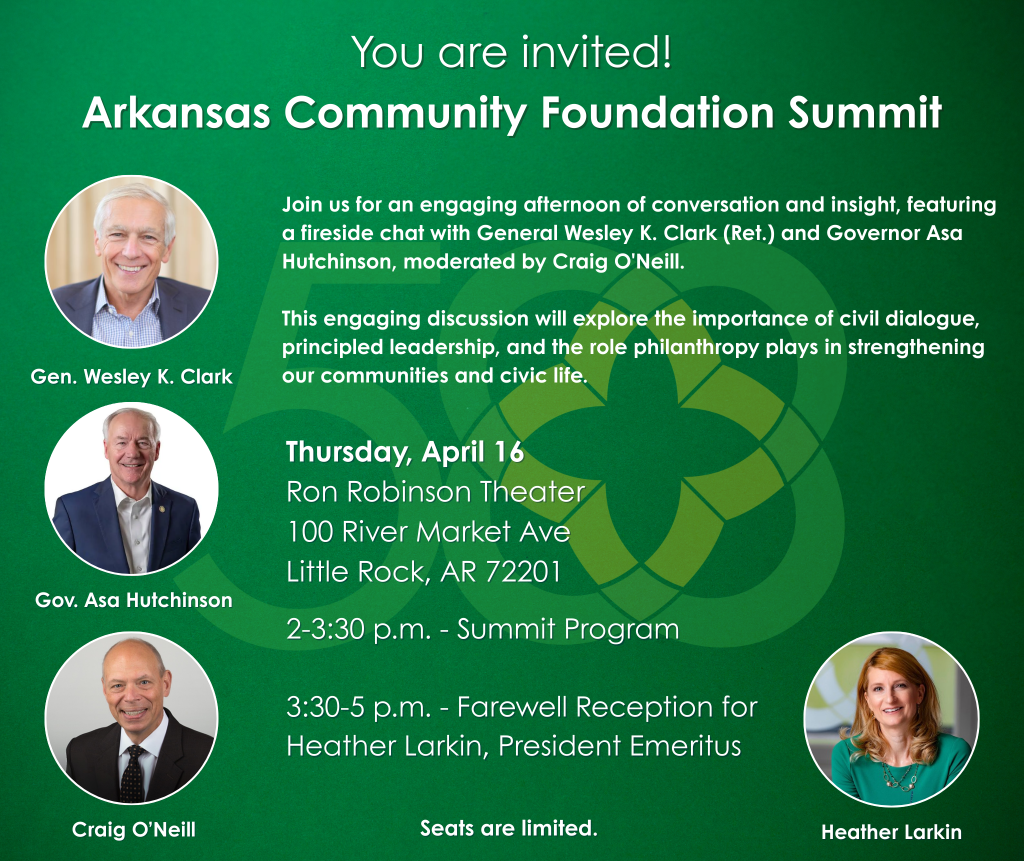
Celebrate 50 Years of Impact with Arkansas Community Foundation on April 16

In 2026, Arkansas Community Foundation marks 50 years of strengthening communities across our state.

We began this milestone year in a big way, awarding $1 million in grants to 47 nonprofits serving Arkansans in critical areas like food security, childcare, and access to education. And now, we invite you to be part of the celebration at our 50th Anniversary Summit.

We are pleased to host a fireside chat with Asa Hutchinson, General Wesley Clark, and moderator Craig O’Neill for this year’s Summit. This engaging discussion will explore the importance of respectful dialogue, principled leadership, and the role that philanthropy plays in strengthening communities. Click here to reserve your tickets.

The Summit will take place at 2 pm on April 16, 2026 at Ron Robinson Theater. If you can’t attend in person, you can watch via the Arkansas TV livestream. Click here to watch live.

Immediately following the Summit, please stay and join us for a special reception honoring Heather Larkin, former CEO of Arkansas Community Foundation. Join us at 3:30 pm to enjoy a drink and hors d’oeuvres while sharing memories, stories, and well wishes as we bid Heather a heartfelt farewell and wish her all the best in her well-earned retirement.

We hope you’ll join us for this meaningful afternoon of reflection, conversation, and celebration as we honor our past and look ahead to the future of philanthropy in Arkansas.

Little Rock, Ark. (March 26, 2026) – Tina Hall has joined Arkansas Community Foundation as its chief communications officer—providing leadership for branding, marketing and communications to advance the organization’s philanthropic mission of community development.

“Tina brings more than 25 years of communications and leadership experience, along with a deep understanding of philanthropy,” said Jessica Ford, president and CEO of Arkansas Community Foundation. “Her leadership in higher education and global nonprofits speaks to her capacity to manage complex operations while guiding a strategic vision. We are truly fortunate to have her on our team.”

Hall has spent more than two decades leading strategic communications and strengthening mission-driven organizations across Arkansas and beyond. For the past eight years, she served as vice chancellor of marketing and communications at Henderson State University as well as executive director of Henderson Foundation for five years.

As senior director of global communications at Heifer International for 12 years, she led global brand positioning, executive communications, creative services, and crisis strategy, supporting sustainable development initiatives worldwide.

An Arkansas native, Hall has deep roots across the state. She earned a bachelor’s degree in English from Henderson State University and a master’s degree in journalism with a news/editorial emphasis from the University of Arkansas at Little Rock.

###

For 50 years, Arkansas Community Foundation has helped Arkansans turn local generosity into statewide impact. Since 1976, the Community Foundation has made more than $600 million in grants to support Arkansas communities and manages more than $1 billion in assets. As part of its 50th anniversary year, the Foundation is making transformational statewide grants and ushering in new leadership to guide its long-term vision for impact. Working through 29 local affiliates, the Foundation partners with donors, professional advisors, nonprofits and community leaders to engage people, connect resources and inspire solutions to build stronger Arkansas communities, forever. 

By Ashley Coldiron, Chief Development Officer

As an attorney, CPA, or financial advisor, you probably work with several clients who own a family business. You’ve likely also considered the role of strategic philanthropy in family business succession planning to help clients get ready for an eventual exit. So how does strategic philanthropy actually play out with a real client? 

Consider Mark and Elaine, long-time owners exploring a future sale. Financial projections confirm a liquidity event would meet lifetime needs. The deeper questions are relational and reputational: What happens to the family’s identity? How will their children remain aligned?

An intentional charitable strategy can provide a bridge.

By contributing a portion of closely held shares to a donor-advised fund before a binding sale, clients may receive a fair market value income tax deduction (subject to AGI limits), and the fund’s share of sale proceeds can avoid capital gains tax.

Equally important, establishing the fund before a transaction creates space to define mission, governance, and next-generation engagement while the business is still operating. Philanthropy becomes a unifying platform—preserving values and strengthening family collaboration.

Our team can facilitate family meetings, provide community insight, and support multigenerational grantmaking—working alongside you as the lead advisor.

A business sale need not signal an ending. With thoughtful planning, it can mark a pivot toward enduring legacy and community impact.

Thank you for the privilege of partnership. Reach out to our team anytime. We are here to help you serve your charitable clients at every stage.

By Jody Dilday, Philanthropic Advisor

Recent rulings reinforce a familiar but critical message: charitable tax benefits depend on strict compliance.

Strict substantiation matters.
In Gibson v. Commissioner, a substantial noncash charitable deduction was disallowed—not because the gift lacked charitable intent, but because substantiation requirements were not met. Contemporaneous acknowledgments, qualified appraisals, and Form 8283 thresholds are statutory—not optional. Regular reminders to clients can prevent difficult outcomes.

Even though you, as an attorney, CPA, or financial advisor may fully understand the importance of following the rules, you still need to remind your clients regularly. You don’t want a client to ask, “Why didn’t you tell us?” when they learn the hard way that they should have kept better records. 

Exempt status requires ongoing alignment.
In Milk Saving Starving Children Foundation v. Commissioner, the IRS’s revocation of 501(c)(3) status was upheld when operations drifted from stated charitable purposes. The case is a clear reminder that mission and activities must remain aligned.

When clients consider supporting lesser-known or newly formed organizations, please reach out. We can provide due diligence insight and offer structured vehicles—such as field-of-interest funds—to safeguard charitable intent.

Our goal is to help ensure your clients’ philanthropy is fulfilled with clarity, compliance, and confidence. Reach out to our team anytime We’re honored to be your first call when charitable giving comes up in client conversations.

By Lesley Roberts, Philanthropic Advisor

Because its Women’s History Month, March offers a natural moment to reflect on the evolving role of women in philanthropy. According to Indiana University’s Lilly Family School of Philanthropy’s Women Give 2024: 20 Years of Gender & Giving Trends, women are increasingly leading charitable decisions. This happens both gradually, as involvement deepens over time, and suddenly, when life transitions require them to assume full stewardship of financial and philanthropic assets.

Four practical considerations for your practice:

1. Plan for consistency in giving.
According to Women Give 2024 report, single women often maintain steady charitable participation even during economic downturns. Thoughtful planning can help sustain impact through life’s ups and downs.

2. Connect national trends to local opportunity.
Giving to women’s and girls’ organizations has grown nationally. Our team can provide local context and opportunities aligned with client priorities.

3. Ask about all forms of philanthropy.
Affluent households are volunteering at increasing rates, and volunteers tend to give more deeply. Ask about both financial support and volunteer commitments.

4. Tailor advice for single women households.
Participation patterns vary by household type. Intentional charitable structures can help single women maximize both impact and planning outcomes.

Whether a client is launching a new fund, refining an existing strategy, or navigating inherited philanthropic responsibilities, we are honored to partner with you. Reach out to our team anytime We’re honored to be your first call when charitable giving comes up in client conversations.

A few thoughtful steps early in the year can bring focus and confidence to your giving:

  1. Review your 2025 giving. We can help you understand the impact of your past gifts, identify patterns, and explore opportunities for the year ahead.
  2. Talk with your advisors early. New tax laws make early coordination especially important. This is also a good time to revisit estate plans and beneficiary designations that may include charitable goals.
  3. Set clear goals for 2026. Whether you want to support favorite organizations, respond to emerging needs, or involve your family in giving, we can help you create a thoughtful, flexible plan.

You don’t have to navigate charitable planning alone. The Community Foundation is honored to serve as your trusted partner—helping you turn generosity into lasting impact for Arkansas, now and for generations to come.

A new year presents an excellent opportunity to check in on your charitable giving priorities. This is the case every year, but it is especially important in 2026 because of a few new tax laws that may impact charitable giving strategies for some people.

Here are the changes that you’ll want to be aware of, and, most importantly, share with your tax advisors as soon as possible. Feel free to forward this article to your tax advisors, or print it and take it to your next meeting.   

New threshold to itemize charitable deductions

One of the most significant shifts affects individual taxpayers who itemize their income tax deductions. Beginning this tax year, charitable contributions will only be deductible to the extent that they exceed 0.5% of a taxpayer’s adjusted gross income. In practical terms, this means that a portion of charitable giving will no longer generate a tax benefit. For example, a taxpayer with an adjusted gross income of $200,000 will see no deduction for the first $1,000 of charitable contributions made in a year. Only donations above that amount will be eligible for deduction, subject to existing percentage-of-income limits. This new rule functions much like a deductible in an insurance policy, raising the effective threshold for receiving a tax benefit and reducing the immediate incentive for smaller annual gifts among itemizers.

Limitation on itemized charitable deductions for high-income taxpayers

High-income taxpayers will face an additional limitation through a new cap on the value of itemized charitable deductions. Even if a donor is in the highest federal income tax bracket, the tax benefit of a charitable deduction will be limited to 35 percent of the contribution. As a result, taxpayers in the 37 percent bracket will no longer be able to offset their income at their full marginal rate when making charitable gifts. 

Good news for the 60% cap

Another important change provides greater certainty for donors who make substantial cash contributions. The long-standing rule allowing cash gifts to qualified public charities to be deducted up to 60 percent of adjusted gross income has been made permanent. After satisfying the new 0.5% AGI floor, donors may continue to deduct cash contributions up to this level, while non-cash gifts or contributions to certain types of organizations remain subject to lower percentage limits. This permanence preserves a relatively generous framework for major philanthropy even as other rules become more restrictive.

New incentive for non-itemizers

The new rules introduce an incentive for taxpayers who do not itemize deductions. Beginning with the 2026 tax year, individuals who claim the standard deduction will be allowed to take a limited charitable deduction above the line, meaning it reduces income before adjusted gross income is calculated. Single filers may deduct up to $1,000, while married couples filing jointly may deduct up to $2,000, provided the contributions are made in cash. This deduction is available in addition to the standard deduction and represents a meaningful expansion of tax benefits for charitable giving among non-itemizers, many of whom have received no tax benefit for donations in recent years. Note, however, that gifts to donor-advised funds are not eligible for this deduction, and neither are noncash gifts. This is unfortunate because both gifts to donor-advised funds and gifts of highly appreciated assets are useful tools that incentivize charitable giving.

QCDs may be even more useful

Retirees and older taxpayers will also see an important adjustment through an increase in the Qualified Charitable Distribution limit. Beginning in 2026, the annual amount that can be transferred directly from an individual retirement account to a qualified charity will increase, allowing taxpayers age 70 ½ and older to direct up to $111,000 to charitable causes without including those distributions in taxable income. Because Qualified Charitable Distributions can also count toward required minimum distributions, this higher limit enhances a tax-efficient giving strategy that is unaffected by itemized deduction limits, adjusted gross income floors, or caps on deduction value.

Limitations on corporate charitable deductions

Corporate donors are not exempt from the new framework. Starting in 2026, corporations may deduct charitable contributions only to the extent that those contributions exceed 1 percent of taxable income. Contributions below that threshold will not generate a current-year deduction, although amounts that exceed applicable limits may be carried forward to future tax years. This new floor is likely to influence corporate giving strategies, particularly for businesses that make consistent but relatively modest charitable contributions. The existing 10% cap on corporate charitable deductions remains in place. 

Again, we strongly encourage you to forward this information to your tax advisors. Please loop us into the conversation so that we can work alongside your attorney, financial advisor, and CPA to ensure that you’re set up to meet your charitable goals for 2026 through strategies that also align with your tax, financial, and estate planning objectives. Whether you cc us on an email, ask your advisor to get in touch with us directly, or pull everyone together on a quick call or Zoom, we are here for you and look forward to the conversation!