
Despite the recently-announced decline in 2022 charitable giving, we continue to hear inspiring stories from you and other fundholders. And we continue to work with new individuals and families to establish their own charitable funds at the Community Foundation, and nothing could make us happier! Increasing charitable giving and connecting donors to important causes are our priorities at the community foundation.

The uptick in conversations about philanthropy has inspired us to reflect on the noteworthy generosity of so many entrepreneurs who become very generous donors and leaders in philanthropy. Over the years, we’ve observed an interesting trend. Entrepreneurs are certainly donors, but are donors entrepreneurs? In other words, is an entrepreneur’s approach to philanthropy similar to the entrepreneur’s approach to building a business? Do they give it like they made it?  

We believe the answer is yes. And often in ways that entrepreneurs–and other donors, for that matter–may not consider. 

Indeed, an “entrepreneur” is sometimes defined as a person who aspires to build something bigger than themself. That’s exactly what happens when a donor supports favorite causes through a donor advised fund at the Community Foundation. This is especially appropriate because contributions to funds at the Community Foundation are much more than simply donations. Contributions are investments in local philanthropy to improve the quality of life in our region and to support the causes the donor cares about. The return on investment is human-centered rather than financial, and those returns deliver benefits to not only the nonprofits who receive grants from the fund, but also to the community as a whole.

Here are few ways that gifts—rather, investments—via a fund at the Community Foundation are similar to entrepreneurship: 

–A gift from one person, one couple, or one household can have a generous ripple effect that “scales” to help many, whether that is to feed many families, subsidize a childcare center, or help support programs that allow parents to work and earn a living.

–Donated funds are the “seed money” that can inspire innovation, the kind that allows the grantee organization to function in new and efficient ways. 

–A gift can expedite creation of the recipient organization’s brand new programs via pilots (in the tech world, “MVPs, ” or minimally viable products). This form of testing and learning is a critical step to achieving product or service viability, whether in the for-profit or nonprofit sector.

–Philanthropic support can provide a nonprofit organization with the means to hire much-needed talent, such as a social worker or a fundraising professional. This is not unlike an entrepreneur’s need to hire key team members, such as a software engineer or a full-time chief financial or accounting officer, who may have otherwise been unaffordable or delayed in coming onboard. 

If you’re interested in reading more about entrepreneurs as philanthropists, you might enjoy specific topics such as making charity a habit, checking out a punch list of five ways to give back, and a few “oldie but goodie” perspectives that have stood the test of time. 

By employing an entrepreneurial mindset, donors can envision and deploy their gifts as investments capable of helping charitable organizations scale to great success and make a real difference in the quality of life for the people they serve. The Community Foundation is always happy to discuss various ideas and strategies to leverage entrepreneurial principles in your charitable giving. We appreciate the opportunity to work together!  

Over the years, you’ve probably taught your young children, grandchildren, nieces, and nephews lessons along the lines of “share and share alike” and “better to give than to receive.” But how do you transition these lessons into more concrete instruction about charitable giving, without risking the youngest members of your family becoming overwhelmed or bored? And how can you make those lessons effective as children grow older?

To inspire teenagers and young adults, consider tapping into an increasingly popular topic among younger generations, which is the notion of “purpose.” “Finding one’s purpose,” in the context of both personal lives and careers, is also a concept that can unite generations within a single family. The overarching purpose of giving can be framed as making the world a better place or strengthening the community. This translates nicely for youth who are seemingly always asking, ”Why?”

Teaching young children about philanthropy can be a little tricky. Many donors and fundholders at the Community Foundation have expressed an interest in learning how to do this. Here are a few principles that might help. And, as always, reach out to the team at the Community Foundation for ideas related to your own particular situation. 

Positive reinforcement is a must. 

As with any successful learning experience, positive reinforcement is a must in teaching the values of charitable giving. In particular, you may want to consider reinforcing that every charitable gift is good regardless of the profile of the giver, the size of the gift, or the nature of the recipient. Positive reinforcement in charitable giving is effective because it first engages the giver’s own understanding of what it means to be philanthropic—from the giver’s own perspective–even if that giver is very young. So when your school-age children or grandchildren are raising money for a charity through a school fundraiser, throwing coins into a fountain to support a local children’s hospital, or donating gently-used toys and clothing, make sure you let the child know that these gifts really do make a difference.

Charitable giving can be defined expansively and inclusively.

When you’re talking with a 10-year-old, conversations about giving back are most productive when they go well beyond discussions about big checks written to highly-visible organizations. You may find it helpful in your conversations to cast a wide net around the definition of what it means to be charitable, often including things like adopting an older dog who needs a home, turning off lights to help the environment, cooking dinner for neighbors in need, helping to pay a family member’s medical bills, and recycling aluminum cans. Your enthusiasm during the conversation will be contagious as you convey the opportunities. The world is full of good deeds waiting to be done!

Tap into what the child cares about.

How do you know what charitable causes might inspire the children in your life? Ask! You’re likely to hear things like animals, trees, natural disasters, finding missing people, and having clean air and water. Any one of these gives you a fantastic opening for further dialogue. Charitable giving opportunities are everywhere!  

Understand that children have a power and direction all of their own.

Even 10-year-olds these days are assertive, aware of news and world affairs, and most importantly, digital natives. They like to figure things out on their own. With the tiniest bit of guidance and a lot of encouragement, their ideas go a long way. Let a child’s interests guide your lesson on giving. You do, however, have a strong power of suggestion as an adult. Kids do not necessarily know how to find the exact names of charitable entities, and they certainly do not know what “501(c)(3)” means, but they remember a place after they’re told it does lots of good for people.

Keep it short and keep it mutual.

The children in your life are brilliant, wonderful, and perceptive, but they do have short attention spans. Make the lessons informal, spontaneous, and flexible, and create plenty of opportunities for storytelling. Children have a story for everything, and they love to share. Let them talk about how they feel. Let them tell you how, where, and why they want to give.

Take action! 

Finally, don’t just talk–take action! For children with a grasp of money, charitable values can be taught through allocations. For the youngest, that may be from their allowance. For the more experienced, allotments can come from after-school or summer job earnings. Giving can be highly interactive or participatory. For example, parents can show children the causes they support or suggest potential grantees based on the child’s interests, and let them choose. Parents can also show them how a gift can be easily made from the family’s donor-advised fund at the Community Foundation, which offers many benefits and can often be named to include names of the child or children. 

At the Community Foundation, we’re here to help your family–even its youngest members–convert ideas into reality for the causes they care about the most. 

For organizations in Cross, Lonoke and Pulaski counties.

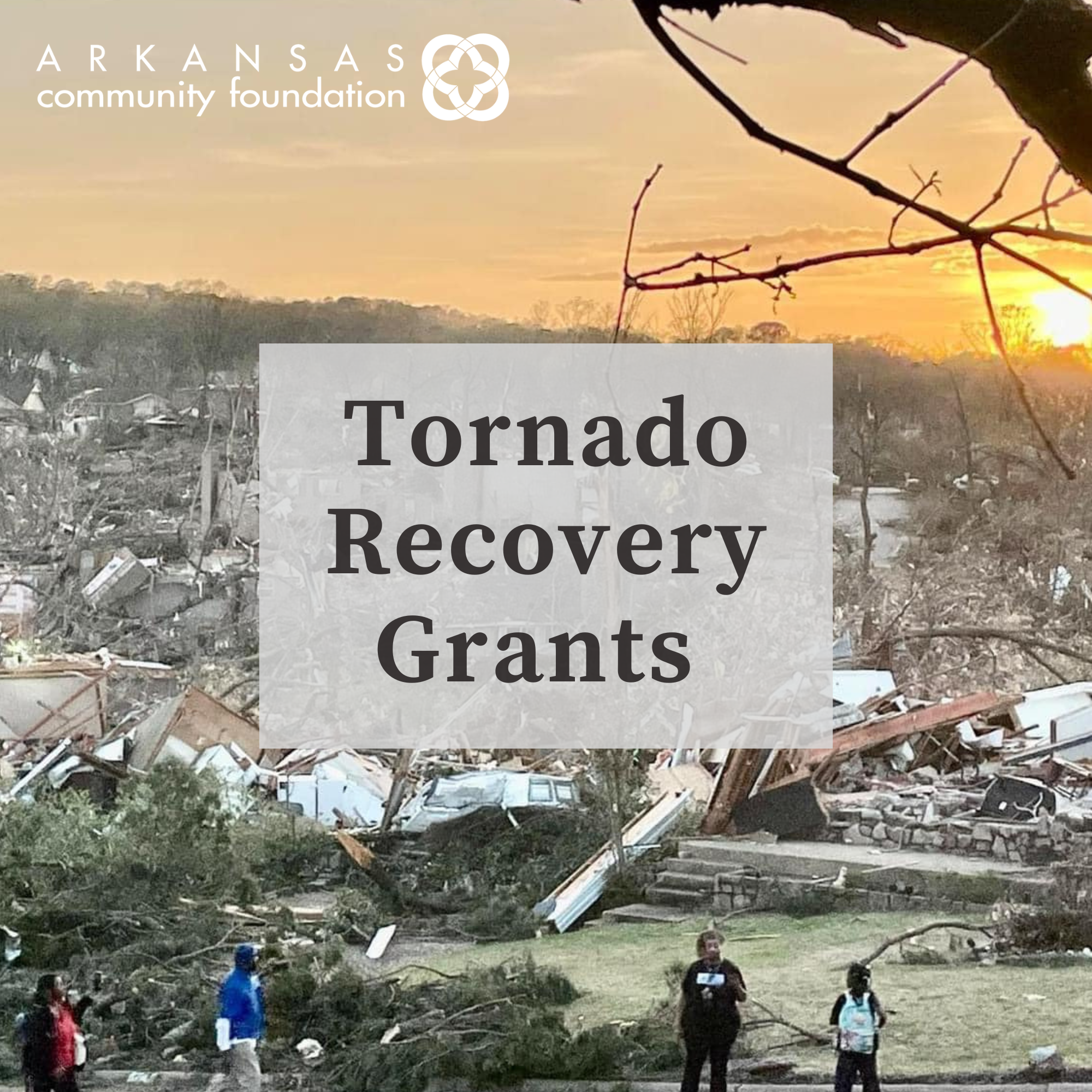
Little Rock, Ark. (Aug. 1, 2023) – Arkansas Community Foundation announces the availability of grants for up to $25,000 to support organizations with programs or projects that are working on long-term tornado recovery efforts in Cross, Lonoke or Pulaski counties.

“Help is still needed for many in central Arkansas and Wynne, especially the uninsured and those who couldn’t access federal or state funds,” said Heather Larkin, president of Arkansas Community Foundation. “These grants will go to nonprofits still working to help people become fully recovered.”

In the wake of the tornados that hit central Arkansas and Wynne on March 31, 2023, the Foundation established the Central Arkansas Tornado Recovery Fund (for Pulaski and Lonoke counties) and the Cross County Tornado Recovery Fund (for Wynne,) to support nonprofits serving these communities’ long-term needs. Hundreds of donors, giving both small and large amounts contributed to the fund collectively raising more than $1 million dollars.

Priority consideration for grants will be given to organizations actively participating in intermediate or long-term recovery by providing:

  • Case management, case work, or other forms of assistance to people navigating insurance, FEMA and social services  
  • Shelter/housing/rebuilding assistance  
  • Debris removal or infrastructure repair
  • Financial assistance and/or basic needs to those affected, but not limited to food/meals, household products, clothing, water, and medicine
  • Legal aid  
  • Mental health aid  
  • Re-establishing programs or educational services that experienced significant disruption as a result of the tornado or directly sustained damage 
  • Other unmet needs  

Grantees will be selected by a committee of local leaders who live and work in the affected communities. Along with the local long-term disaster recovery committees, representatives from Pulaski and Lonoke County will review central Arkansas applicants and Cross County Community Foundation’s board will review Wynne applicants. Applications will be accepted from August 1 – August 31, 2023.

Full criteria and applications details are available at www.arcf.org/tornadogrants. The deadline for organizations wishing to be considered is 11:59 p.m. on August 31, 2022. For questions call 501-372-1116 or email arcf@arcf.org.

Arkansas Community Foundation and Cross County Community Foundation do not provide direct programming or immediate relief work. They rather focus on long-term and intermediate recovery through grantmaking to nonprofits serving the affected areas.

Arkansas Community Foundation, a statewide nonprofit organization, provides resources, insight and inspiration to build better Arkansas communities – communities where our kids will want to raise their kids. The Community Foundation is the largest grantmaker in the state in the number of grants made each year. Since 1976, the Foundation has provided more than $393 million to nonprofits. The Foundation staff works directly with donors, professional advisors and nonprofits to help strengthen Arkansas communities through strategic philanthropy and focusing on local needs. Its assets rank among the top 60 out of more than 800 community foundations in the United States. Serving statewide and local initiatives, the Community Foundation helps connect those who want to give to causes they care about. Contributions to Arkansas Community Foundation, its funds and any of its 29 affiliates are fully tax deductible.

###

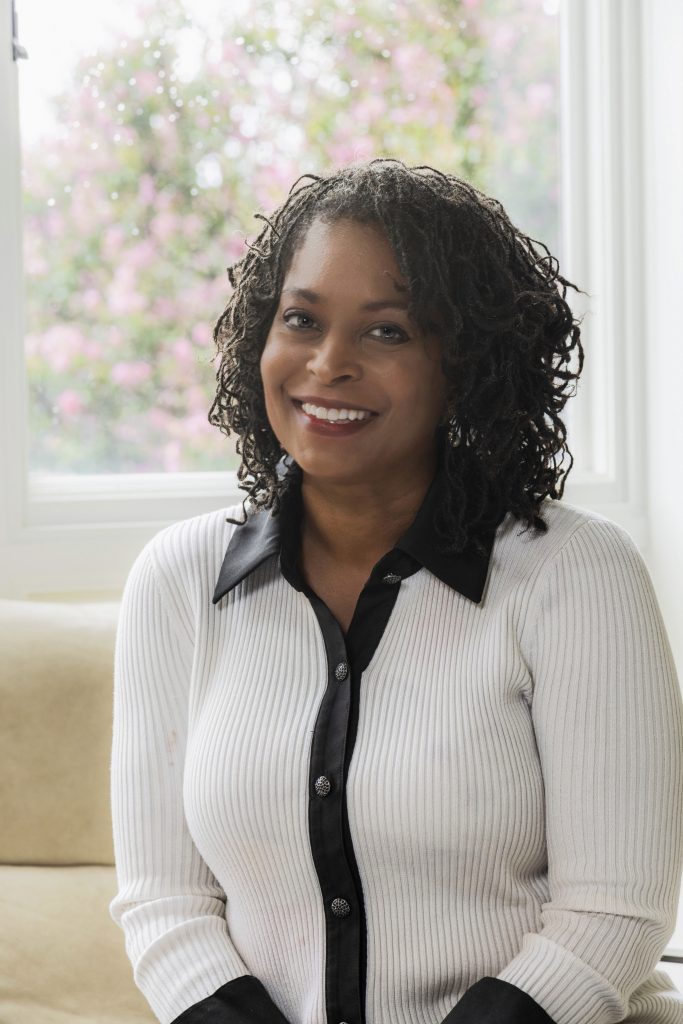
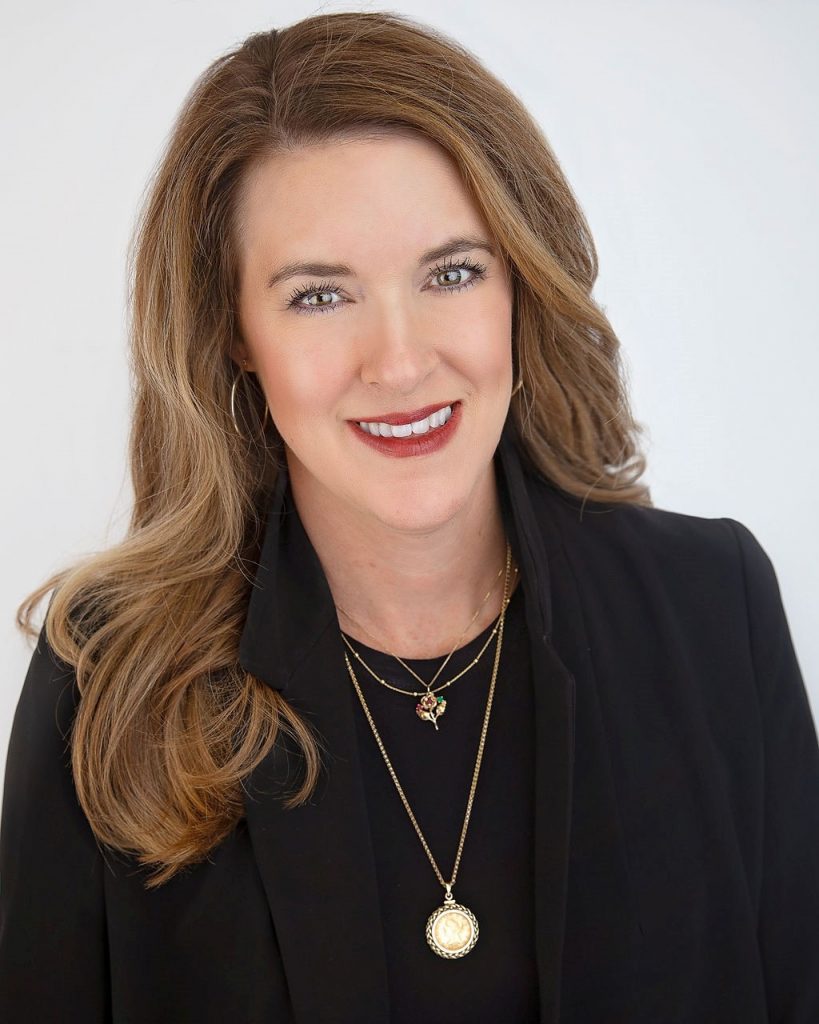
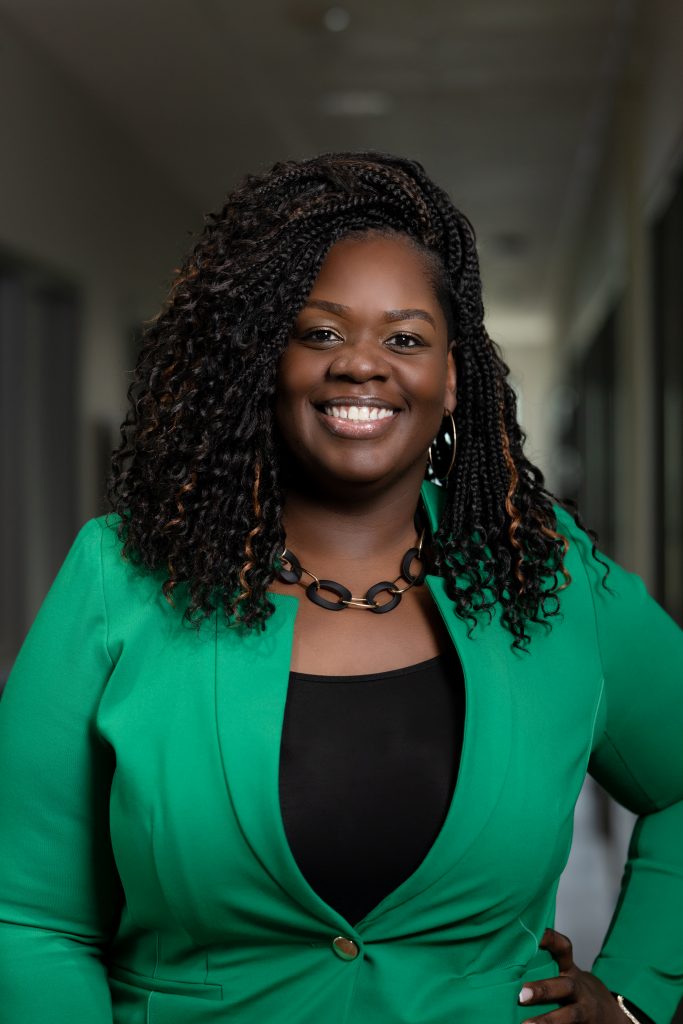
Little Rock, Ark. (July 25, 2023) – Arkansas Community Foundation, a statewide nonprofit that offers tools to help Arkansans protect, grow and direct their charitable dollars announces the election of Alyson Bradford of White Hall as board chair, along with the election of new board members, Elizabeth Burns Anderson of Lonoke and Jennifer Ronnel of Little Rock.

“We are thrilled to welcome Alyson’s leadership as chair to our board of directors along with Jennifer and Elizabeth as new members,” said Heather Larkin, President and CEO of Arkansas Community Foundation. “These leaders will provide excellent guidance to our statewide network. They each bring a unique perspective to our board.” 

Alyson Bradford

Alyson Bradford, the new chair, is a graduate of Kansas State University and a small business owner and agent for State Farm Insurance Company. As the first State Farm agent to open an emerging market agency in State Farm’s Mid-South region, she opened her business in the heart of the lower to moderate income area of North Little Rock where she focused on growing the African American and Hispanic markets.

Bradford will be leading the statewide organization’s 18-member board, including two newly elected members, Anderson and Ronnel.


Elizabeth Burns Anderson

A fifth-generation banker and native of Magnolia, Elizabeth Burns Anderson is Senior Vice President of Farmers Bank and Trust and Executive Director of the Farmers Bank Foundation. She is a graduate of the University of Arkansas with a degree in Finance.  In 2020, Governor Asa Hutchinson appointed Anderson the patient representative of the Arkansas State Medical Board where she will serve until 2027. 


Jennifer Ronnel

Jennifer Ronnel is a Huntsville, Alabama native and graduate of the University of Texas and Harvard Law School. She was admitted to the District of Columbia and Arkansas Bars in 1996. Ronnel is Senior Counsel at Metal Recycling Corporation.  She and her husband, Steve, have three children and are residents of Little Rock. 

###

Arkansas Community Foundation, a statewide nonprofit organization, provides resources, insight and inspiration to build better Arkansas communities – communities where our kids will want to raise their kids. The Community Foundation is the largest grantmaker in the state in the number of grants made each year. Since 1976, the Foundation has provided more than $393 million to nonprofits. The Foundation staff works directly with donors, professional advisors and nonprofits to help strengthen Arkansas communities through strategic philanthropy and focusing on local needs. Its assets rank among the top 60 out of more than 800 community foundations in the United States. Serving statewide and local initiatives, the Community Foundation helps connect those who want to give to causes they care about. Contributions to Arkansas Community Foundation, its funds and any of its 29 affiliates are fully tax deductible.

CAMDEN, ARK. (Aug. 15, 2023) – Krystal C. Moore of Camden has been named executive director of Ouachita Valley Community Foundation, an affiliate of Arkansas Community Foundation. The Community Foundation supports countywide nonprofit organizations through funding, networking and capacity building opportunities.

“Krystal brings many years of experience plus a wealth of knowledge,” said Heather Larkin, president and CEO of Arkansas Community Foundation. “Her leadership skills and perspective will prove extremely valuable to the Ouachita Valley affiliate.”

Moore has found success in the financial banking industry and serves as a business banking and community liaison. Moore has over twenty years of experience in the financial banking sector across Arkansas. Locally, she has been an integral part of Plant Seed organization, started by her father in Camden to service the youth and seniors of the community. She has a passion for family and community.

For more information about the Foundation’s work in Ouachita Valley, contact Moore at ouachitavalley@arcf.org or 870.290.3175. You can also visit www.arcf.org/ouachitavalley to learn more about local grantees and Foundation activities in the Ouachita Valley area.

###

Arkansas Community Foundation, a statewide nonprofit organization, provides resources, insight and inspiration to build better Arkansas communities – communities where our kids will want to raise their kids. The Community Foundation is the largest grantmaker in the state in the number of grants made each year. Since 1976, the Foundation has provided more than $393 million to nonprofits. The Foundation staff works directly with donors, professional advisors and nonprofits to help strengthen Arkansas communities through strategic philanthropy and focusing on local needs. Its assets rank among the top 60 out of more than 800 community foundations in the United States. Serving statewide and local initiatives, the Community Foundation helps connect those who want to give to causes they care about. Contributions to Arkansas Community Foundation, its funds and any of its 29 affiliates are fully tax deductible.

FORT SMITH, ARK. (Aug. 15, 2023) – Jessica Fulbright Hayes of Fort Smith, has been named executive director of Western Arkansas Community Foundation, an affiliate of Arkansas Community Foundation. The Community Foundation supports countywide nonprofit organizations through funding, networking and capacity building opportunities.

“Hayes brings many years’ experience, plus a wealth of nonprofit knowledge,” said Heather Larkin, president and CEO of Arkansas Community Foundation. “Her leadership skills and expertise will prove to be extremely valuable to the Western Arkansas affiliate.”

After graduating from college with a biology degree, she moved to Little Rock and enrolled in the Public History program at UALR. There she began her work on “A Gathering of Women,” a traveling exhibit on women in Arkansas, and “Life Interrupted,” a multi-million-dollar project on the WWII Japanese-American camps in Arkansas. After returning to Fort Smith in 2007, Hayes held leadership positions at the U.S. Marshals Museum and The Montessori School of Fort Smith, where she served as head of school for the past nine years.  

For more information about the Foundation’s work in Western Arkansas, contact Hayes at westernarkansas@arcf.org or 479-315-6428. You can also visit www.arcf.org/westernarkansas to learn more about local grantees and Foundation activities in Western Arkansas. 

###

Arkansas Community Foundation, a statewide nonprofit organization, provides resources, insight and inspiration to build better Arkansas communities – communities where our kids will want to raise their kids. The Community Foundation is the largest grantmaker in the state in the number of grants made each year. Since 1976, the Foundation has provided more than $393 million to nonprofits. The Foundation staff works directly with donors, professional advisors and nonprofits to help strengthen Arkansas communities through strategic philanthropy and focusing on local needs. Its assets rank among the top 60 out of more than 800 community foundations in the United States. Serving statewide and local initiatives, the Community Foundation helps connect those who want to give to causes they care about. Contributions to Arkansas Community Foundation, its funds and any of its 29 affiliates are fully tax deductible.

CLARENDON, ARK. (Aug. 15, 2023) – Marqita Ervin of Clarendon has been named executive director of Monroe County Community Foundation, an affiliate of Arkansas Community Foundation. The Community Foundation supports countywide nonprofit organizations through funding, networking and capacity building opportunities.

“Marqita brings a wealth of knowledge to this role,” said Heather Larkin, president and CEO of Arkansas Community Foundation. “Her leadership skills and experience will prove to be extremely valuable to the Monroe County affiliate.”

Ervin was born in Ohio and her family relocated to Clarendon when she was three years old. Graduating from Clarendon High School in 2001, she chose to serve her country by enlisting into the United States Navy. While serving, Ervin was an Information Systems Technician and obtained certifications in JCDX System Administration. Service has always been important not only to her country, but also in her community as a volunteer with VFW Post 1985 and the American Legion Hall Post 77.

After five years in the Navy, Ervin held various roles including account manager for an independent music label, licensed esthetician and most recently, site manager at Randstad USA for Lennox International.

For more information about the Foundation’s work in Monroe County, contact Ervin at monroecounty@arcf.org or 870-290-3175. You can also visit www.arcf.org/monroecounty to learn more about local grantees and Foundation activities in the Ouachita Valley area. 

###

Arkansas Community Foundation, a statewide nonprofit organization, provides resources, insight and inspiration to build better Arkansas communities – communities where our kids will want to raise their kids. The Community Foundation is the largest grantmaker in the state in the number of grants made each year. Since 1976, the Foundation has provided more than $393 million to nonprofits. The Foundation staff works directly with donors, professional advisors and nonprofits to help strengthen Arkansas communities through strategic philanthropy and focusing on local needs. Its assets rank among the top 60 out of more than 800 community foundations in the United States. Serving statewide and local initiatives, the Community Foundation helps connect those who want to give to causes they care about. Contributions to Arkansas Community Foundation, its funds and any of its 29 affiliates are fully tax deductible.

By Kim Dishongh

Usually when a university president discusses growth, he is referring to academics, student enrollment or budgets. Richard Dunsworth, president of the University of the Ozarks in Clarksville, has plenty to say about those topics — but he might also share updates on his crops. He put in a garden behind the president’s residence on the edge of campus and he regularly enjoys the fruits — and vegetables — of his labor.

Richard Dunsworth, president of the University of the
Ozarks, put a garden on the edge of campus.

In recent years, he has worked to cultivate partnerships geared toward making it easier for everyone in the area to access fresh, locally produced foods, and is now leading a university initiative to open a farm-to-table restaurant and taproom in a historic building within easy walking distance of campus.

“The front of the building will be a place to be able to buy fresh produce and things made and grown here in Arkansas. You can also grab a cup of coffee and a bagel and maybe some ice cream and things of that nature,” said Dunsworth. “But it’s all designed around how to support Arkansas growers and Arkansas entrepreneurs.”

“We’re partnering with our city and our chamber of commerce to locate the community farmer’s market there,” said Dunsworth.

“Let’s say you’re a small farm and you’ve got produce of some kind that you bring into the farmer’s market. You sell everything you can and then you can go into the warehouse and package it for sale in the market, or you might decide to drop it in the dehydrator or the freeze dryer so you don’t lose it,” said Dunsworth. “In many ways it’s all about knowing where your food comes from and being able to shake hands with somebody who you know produced the meat and vegetables you’re eating.”

“Dr. Kim Van Scoy, who ultimately built a sustainable agriculture minor here at the university, started a community garden,” says Dunsworth.

Van Scoy, who retired last year, called it the Food for Thought garden.

“The class decided they wanted to call the garden the Food for Thought garden because we would hopefully help provide food in our local community, which would help with the fact that we were a food desert,” said Van Scoy. One third of the produce from the garden was donated to a school backpack program, serving children in Clarksville schools, where about 70 percent of students qualified for free and reduced lunches. Another third was sold in a farmer’s market and the remainder went to the students who worked in the garden.

Dunsworth explained that the university is better situated to absorb some of the risks that, for small businesses, might be catastrophic.

“What we’re trying to do is lend our knowledge of what we know about running nonprofits, what we know about business and marketing, what we hope our students can learn in this process,” he said. “Let us be the hub that just puts a whole lot of spokes out there and supports small farms that are kind of a side gig, a secondary opportunity for people to make money, and the outcome is for our students, who may not have ever understood where food really comes from to maybe understand a little bit more.”

Differing views within families is nothing new. For generations, common topics of disagreement have included: popular culture, politics, religion and parenting, just to name a few. Frequently outranking all is money: how it is made, how it should be spent, how much should be saved.  How benevolent families share money is a topic all its own. It has perhaps never been more relevant than now given these realities:

  • up to four generations living simultaneously,
  • longer lifespans,
  • more willingness to discuss family finances,
  • differing social views,
  • and the desire of older generations to set a good philanthropic example while retaining some control of assets built over many years. 

 It seems the discussion about sharing will likely continue for decades.  

According to figures cited in a May 2023 New York Times article (subscription required), total U.S. family wealth of $38 trillion in 1989 more than tripled to $140 trillion in 2022, with Baby Boomers and Generation X holding 90% of that. By 2045, older Americans will pass down a projected $84 trillion to Millennial and Gen X heirs, with $16 trillion transferring by 2033. With evermore wealth circulating, both ideas and conflicts about its use will likely result.  

As an advisor, it is your responsibility to help your clients achieve their goals for their estate plans, financial plans, and charitable objectives. As you work with your multi-generational philanthropic clients, you have no doubt noticed that even a subject as uplifting as philanthropy can lead to lively discussions and sometimes even disagreements. To fulfill your role, you will need to lean on strategies to navigate conversations about charitable priorities when not everyone is on the same page.  

You can also lean on the Community Foundation–and we encourage you to do so! Community foundations occupy a unique position in the midst of the unprecedented wealth transfer now underway: that of arbiter, guide and even peacemaker among benevolent multi-generation families. In addition to understanding the needs of the community, the nonprofits and programs that are addressing those needs, and the ins and outs of the tax vehicles best suited for your clients to help meet those needs, our team is also deeply experienced in facilitating productive dialogue among people who bring valuable, diverse viewpoints to the table. 

As a secure, convenient, and trusted partner to help a family invest wealth in charitable causes, Arkansas Community Foundation can help you work with your philanthropic clients in a variety of ways:

–Our team focuses on listening to understand the cross-generational and intra-generational values of a family.  

–We ask a lot of questions about what causes matter to your clients and the origins of those preferences, both historically and now.  

–When possible, we pair Community Foundation staff with family members to align according to personality and generation to foster more intimate, empathetic, and meaningful discussions. 

–Our team seeks to understand a family’s values, and then we research and suggest potential grantee organizations or causes if the family is seeking input. We can also deeply research organizations that the family is already supporting.  

–The Community Foundation offers to educate the various generations about the tactical opportunities including donor advised funds, field of interest funds, unrestricted funds, designated funds, and anonymous giving, among others.  

–Our team is happy to develop options for multi-cause allocations that peacefully meet the needs of all involved. 

–For geographically dispersed generations, our team offers to meet at agreeable intervals, even digitally, to understand a family’s current and changing views.  

We are here for you and the philanthropic families you serve. As the needs, capabilities and opinions around wealth expand, the Community Foundation can be a facilitator of conversations, connection, and contributions among well-intended but independently-minded families and help you carry out your professional responsibilities.

At the Community Foundation, we regularly work with legal, financial, and tax advisors like you to help clients reach their charitable goals.  As a professional who regularly works with charitable clients, you are no doubt well aware of the tremendous benefits to both clients and charities when a client names a charity, such as a fund at the Community Foundation, as the beneficiary of an IRA or other qualified retirement plan. So how can you help a client plan ahead to maximize a bequest of retirement fund assets, as well as support increased giving during the client’s lifetime?  A great way to do this is by encouraging clients to maximize their IRA contributions—for many reasons:

  •  Taxable income “suppression” in the year of the contribution. 
  • Tax-deferred growth until distribution—and now not required until age 73 of the account owner.
  • Ease of changing a beneficiary designation to name the client’s fund at the Community Foundation, which will remove the assets from the client’s taxable estate at death and avoid income tax. 
  • With retirement plans flowing to charity, leaning into highly-appreciated stock and other property at stepped-up values to make bequests to family or others, effectively erasing the unrealized capital gains for the recipients. 
  • The Community Foundation makes it EASY to give using your IRA.

 Make sure your charitable clients don’t overlook an important tool in retirement savings maximization (and ultimately charitable giving) known as the “catch-up” contribution. This is the “extra” money that retirement savers aged 50 or older can stash away into their retirement accounts—and into more than one account as applicable.  Advisors and clients might better think of this as a bonus opportunity rather than a “catch-up,” especially if a client has been maximizing their retirement savings all along. Additionally, of course, the catch-up contribution allowance helps a client make up for years when retirement contributions fell short due to earnings or savings interruptions due to layoffs, caregiving, high-expense years or similar circumstances.   Thanks to the SECURE Act, catch-up contributions have created even more buzz about opportunities for retirement savings, especially as the rules are set to shift in 2024 and 2025. In any event, the effects can be impactful. For example, an extra $1,000 deposited annually from age 50 through 65 earning 6% on average could potentially deliver an extra $27,000 in retirement income at age 65.  From a charitable giving perspective, the greater the IRA balance, the more opportunity there is for a client to give later to a fund at the Community Foundation. What’s more, higher IRA balances can motivate your clients to deploy a Qualified Charitable Distribution strategy, with its many benefits: 

  • Beginning at age 70 ½, your client can make Qualified Charitable Distributions (QCDs) up to $100,000 in 2023 ($200,000 for married couples) and indexed for inflation beginning in 2024.
  • QCD assets can be distributed to a designated or field-of-interest fund at the Community Foundation or to another qualifying public charity.
  • QCDs can count toward Required Minimum Distributions for clients who are required to take them.

 All in all, IRAs are the most prolific retirement savings vehicle in the United States, accounting for nearly 33% of the $33 trillion of total retirement assets as of December 2022. But regardless of the retirement savings vehicle, contribution maximization—and aided by so-called catch-up contributions—is a winning strategy for wealth building, family gifting, and charitable giving.